Falling in love with my carers

I have historically thought of myself as a relatively strong and independent person although I am discovering that I am much more dependent and weak than I had thought. One of the strange things is that I find myself falling in love with my carers. That sounds weird, I know, so I better clarify my meaning.

I’m sure you have heard of patients falling in love with their nurses. Some of these passions end in marriage but most go unfulfilled. Aside from hospital codes of practice that probably prohibit such relationships, a nurse/patient bond is not an equal one. It is a relationship of dependency, where one person is needy and the other giving. In reality the “love” that a patient is feeling is that of a child for a parent – except the carer inevitably views the relationship very differently than does the cared-for. For them, the connection is a professional one, and it invariably ends when the professional connection ceases and the next stage in the patients recovery occurs. It has to be so – the carer has more patients to support. But it is really hard for a patient to get used to.

My first experience of this was when my occupational therapist, Peta, changed jobs. It is hard to describe what she meant to me. She had spent countless hours helping me do tiny tasks on the way to being able to function with this stupid damaged body. She was also the person who got me out of bed and into a chair. I was shattered when she told me that the hospital was moving her to a different department. My concern wasn’t just functional. It wasn’t just the thought that the next person would not be as capable of doing the job. I had come to love her, not in a boyfriend/girlfriend way, and it is hard to label my feelings toward her. Love probably is the wrong word, but for me the connection was deeply emotional, and its conclusion took some getting used to.

Surprise, surprise, her replacement, Ally, turned out to be equally “lovable”. Again she gave diligent attention to my care, and was a constant source of inspiration and joy. Leaving hospital was something I very much looked forward to, except the thought of ending the relationship with Ally. It felt something like a divorce. We remain friendly but for all intents and purposes the close friendship we had shared was over. It had to be, since the functional reason for the relationship had ended. I knew this in my head, but the emotional dependency that had formed within me – my neediness – struggled to adapt to the change.

There are at least two others in hospital that I felt the same way about. The first was a nurse, Louise, who looked after me in the acute spinal ward. These were the days long before I could feed myself (a task I can now perform even if I am messy enough to still require a bib!). She would feed me, encourage me, and look after all the yucky things that come with broken bodies, and all the while encouraging me, helping me to smile and laugh, and simply being a light in a dark place. My physio, Keira, was likewise an amazingly beautiful companion. She spent more time with me then anyone else, and was part of my care for pretty well the whole time I was in hospital. I remember one time a couple of young guys talking about Keira as young guys do. I felt like beating them to a pulp, except of course they would have been fairly safe (my seven-year-old nephew can beat me in an arm wrestle). Keira is easy to fall in love with. She is caring, genuine and encouraging. And again it is hard to describe what it is like to realise that such friendships are largely professional. And I don’t say this to imply any criticism of any of these amazing women. They are of course all still friends – but perhaps as time goes on it is a “Facebook” type friendship.

Now, lest one thinks that the real motivation behind my “love” was the fact that all of these carers were pretty, I should note that I once fell in love with a man. Peter was a physiotherapist involved with saving my life in ICU. He would give me assisted coughs when I couldn’t breathe during the early days of my recovery. His care, like that of all the others, went beyond the merely functional. He was an encouraging friend and, yes, when the situation moved me on it was simply difficult to face the fact that I would have to get used to not having him around.

Well I am now out of hospital, and my care has been transferred to the spinal outreach service. My key contact is another amazing woman, Emma (most of my carers have been women – a fact that says something about gender tendencies/stereotypes that I should discuss another day). She is a generous and beautiful soul. Unfortunately, the SOS service is only provided for 18 months after discharge. I am already finding this thought challenging. It is not only my worry about the support that I won’t receive after this time. It is also the realisation that another care relationship will end. And I really like Emma!

Yesterday, two of my personal home carers resigned. These two lovely ladies had looked after me morning and night for six months. They had become part of the scenery of the home – dealing with my intimate personal needs. I wasn’t always pleased to see them – waking me up in the morning and putting me into bed sometimes too damned early! But they made it bearable and sometimes even enjoyable. Now they’re gone and next week someone new. Rachelle, Paveen  – don’t leave me!

Now, I realise this it is an utterly strange blog post. I hope it is not one that makes my carers uncomfortable – that was not my intention, since they are all amazing people. What stands behind all of this is the realisation that I am needy – not just physically, but emotionally. I am most fortunate that the deepest love that I have is for (and from) my wife, an amazing intelligent, creative, supportive, caring, generous and beautiful person. Beyond the care of all of the amazing professionals that have helped me along the way, my wife has been there from beginning to end. I simply could not have survived without her. I am loved by and I love a lot of people. But so much more, I am deeply in love with and utterly dependent on Elly.

About these ads

Thinking about sex?

Shane and Rachel (Elly) Clifton's wedding, 9 December 1989

In the next couple of weeks I will be teaching on the topic of sexual ethics. I am sure that sex is on the mind of many of you. In fact, I can say with confidence that it is likely to be on the mind of at least half of my male readers. There is an urban myth doing the rounds that men think about sex every seven seconds – a stupid myth really, especially if we take as a given another myth, that men are incapable of doing or thinking two things at once. Research does suggest, however, that “54% of men think about sex every day or several times a day,” women less frequently (see here). This variation is presumably a result of the difference between testosterone and oestrogen. Whatever the statistics, we think about sex a lot. No surprise, really, in a sexually saturated society such as ours.

Sex is certainly on my mind, and has been for some time. A few months into my hospital rehab my doctor ordered that I have a cat scan. He was worried that I had brain damage because the medical staff noticed a change in my behaviour and mood (for obvious reasons, broken necks and brain damage often go together). I was, ordinarily, an easy-going patient. While many people treat nurses like slaves, with demanding and aggressive attitudes, I think I can say (without being boastful) that I got on well with all the staff. Except, apparently, when the cat scan was ordered. I had shocked some of the doctors and the nursing unit manager with my seemingly out of character demands for a private room; insistent, aggressive, even angry (my apologies to those who bore the brunt of my attack). My family, and those staff who knew me better (Louise, Ally, Keira) understood that the issue was not brain damage. I can and do lose my cool. And after months without any sexual contact, I was longing for the opportunity to close a door and ravage my wife.

Well, it turned out that my brain was fine (or at least unchanged by my accident; whatever is wrong in my head it has always been that way!). I also was given a private room. Ravaging my wife proved more complex. Apart from the fact that so-called private rooms in hospital are not at all private, with nurses and doctors coming in and out almost constantly, spinal-cord injury and sex are not good ‘bedfellows’. This is not only because certain parts of the anatomy don’t work too well. Equally problematic is the blobby body. It’s hard to express passion when lying on a bed unable to move or when stuck in a clunky electric chair.

You would not be surprised to hear that the impact of spinal-cord injury upon sexual function is one of the most difficult things to try to come to terms with. On New Year’s Eve one of the younger men in hospital came to my room and broke down. A fit, strong and determined paraplegic, there was no doubt that he would succeed in life despite his injury. But he simply did not know how to face life without sex and orgasm. To be honest, I had no idea how to comfort him. So we shared a Scotch and then went and watched the fireworks. A depressing end to the year, but at least we could be depressed together.

Now, I have no idea why I’m telling you all this (am I mad exhibitionist?). I am sure you don’t need any more details. I’m also told the story is not all negative. Sex is not just penetrative intercourse (and even this is not impossible for many with spinal injuries), and intimacy and touch depend more upon love and commitment than upon simple bodily function. But I am motivated to encourage you to make the most of your opportunities and enjoy the wonders of the human body. As a Christian I am part of a tradition that has too often had horribly negative attitudes towards sexual pleasure. Indeed, the history of the church’s perception on these issues makes for depressing reading:

  • Origen (c.185 – c.254) castrated himself.
  • St Augustine thought that “nothing so casts down the manly mind from its height as the fondling of a woman.’ (See Thomas Aquinas’s citation and his own depressing attitude here).
  • Following Augustine, celibacy became the norm for priests – the sacred and the “venereal” kept well apart
  • the penitentials of the Middle Ages (rules for penance) had long lists of penalties for sexual sin, requiring fasting for nocturnal emissions, masturbation and many other things – see here

All very sad when you think about it. It also makes no sense when you consider the long Christian tradition of asserting that faith and happiness go hand in hand (see my earlier posts on the connection between virtue and happiness). It is beyond my capacity here to provide a theological defence of the joy of sex. But I can provide a personal one, since my injury and my loss gives me a unique perspective. Sex is one of the great pleasures of life, especially when connected to a committed relationship, since intimacy and love make for truly satisfying loving. There is also joy in the simple (and natural) experience of orgasm. This is something we shouldn’t be embarrassed about, although I suspect St Augustine still influences our culture (mostly for better but sometimes for worse). But I say, make the most of your time – wring all you can out of life. Enjoy yourself. Don’t take your sexual capacity lightly. This means you shouldn’t throw it around willy-nilly. The forgotten virtue of restraint is the enemy of true sexual pleasure. But it also means you should make the most of the opportunities life gives you. Celebrate life and love. Enjoy your bodies. You may not have them for as long as you think.

The tale of two birthdays

A lot can happen in a year – here is a pictorial tale of two birthdays;

birthday 2010

Birthday 2011

Shirt, no pain no Shane – seems appropriate (another of my wife’s brilliant T-shirts)

Recollections – when not to listen to Norah Jones

Well it turns out that I have not been very motivated to blog my recollections one year on. Difficult week to be honest, and sometimes one feels like there is just nothing worth saying. Who knows whether I might take a stab at it next week – I’ll leave that decision to my mood at the time.  in any event, I’m going to spend tomorrow focusing on my brilliant and gorgeous wife, who graduates with a bachelor of arts (major fine arts) from the Australian Catholic University. I will say more about this tomorrow, and try not to think about my own anniversary.

In the meantime, one quick recollection. My beautiful friends Kate and Andrew Tennikoff brought me some wonderful headphones and an iPod with some music to listen to an intensive care. Music has a power in times of crisis and so I asked the nurse to place the headphones on my ears and turn on the iPod. The album selected was by Norah Jones and it wasn’t long before I realised my mistake. Her music has a haunting quality and is intensely emotive. Within a minute I found myself crying my eyes out. The problem was that I was trapped in bed, without arms or hands to the iPad off or remove the headphones. It was probably only 10 min or so before my distress was noticed, but it felt like much longer.

I want to walk with you

On a cloudy day

In fields where the yellow grass grows knee-high

So won’t you try to come

Come away with me and we’ll kiss

On a mountaintop

Come away with me

And I’ll never stop loving you

Try listening to that song on a dark day, with your arms tied behind your back. The definition of torture!

http://youtu.be/c1V5Wk9gb4U


screwed

Almost one year on – the fateful day

On 7 October it will be the one year anniversary of my accident. As we lead up to this auspicious day, I thought it might be of interest for my wife and I to post a few recollections on our experience of the past year.

I guess the obvious place to start is the day itself. It was mid-semester break and my family and I were staying with my parents at beautiful Callala Bay. The morning of the seventh started perfectly with an early surf in a crisp swell with offshore breeze. There is no doubt that surfing is one of the things I miss the most, and I still find myself looking longingly at waves. But it is, at least, a nice thought that my last day with legs included embracing the joy of the waves.

Returning from the surf the family was keen to head into Nowra. My boys, especially the oldest Jeremy, had been longing for some weeks to have a go at the skate/bike jump that had been set up for the youth group at Nowra City Church. The generous pastors Peter Pilt and Simon Clegg were happy to oblige, so off we all went – my wife, my boys and my mum – to the church.

The kids were having a great time, and I’d seen photos of other “old men” like me using the jump. It looked safe, as the landing was a seemingly soft pit full of foam. Grabbing a pushbike off I went, into the air and landed unspectacularly in the pit.

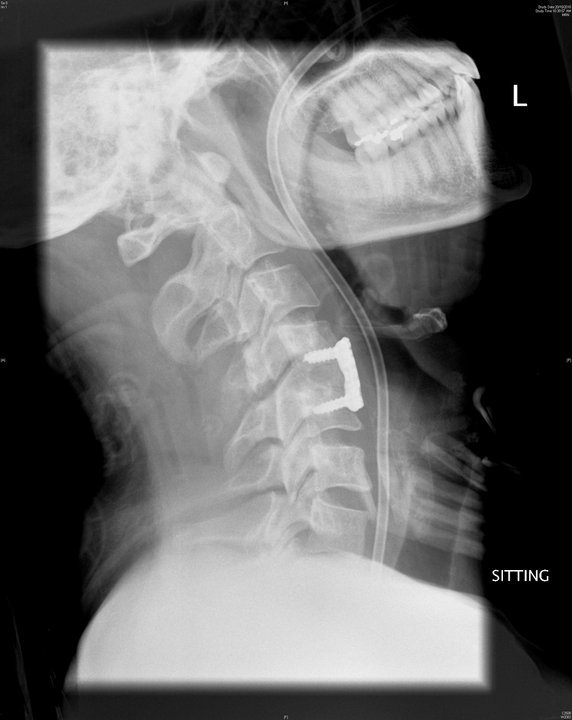
I knew instantly I’d broken my neck. I did not black out but I simply could not move anything. I shouted out as much to my wife who was videoing the jump (we have a video but I have not had the fortitude to see it). She thought I was joking, but my repeated avowal created instant shock waves. Elly and others came into the pit. With my head under the foam I was struggling to breathe and I pleaded to be lifted up. Wisely, they moved the foam around my face but kept me still. Thank God, because movement could have worsened the damage, further crushing the nerve cord (although I’m not sure what it means to thank God in this situation – can you be thankful that things are not worse when they are bloody terrible?). An ambulance was called. Paramedics arrived, stabilised my neck. A helicopter thundered in. Sometime later I was taking the 23 min flight from Nowra to Prince of Wales Hospital – my first in a helicopter!

It is impossible to describe the feeling of the seconds and minutes and hours that follow spinal-cord injury. On the one hand it is surreal; a phantasm – the “feeling” of moving an arm or leg, but no response. On the other hand you are consumed by utter panic, by the sense that this cannot be real, but the certain knowledge that it is. It is simply overwhelming, the realisation that your whole life has changed and, perhaps worse, that you have placed a terrible burden upon your wife and family. I remember apologising to Elly. I remember being thankful that it was me and not one of my sons lying on the stretcher. I remember kissing my family goodbye. I remember the paradox of pain, yet having no feeling. I remember drowning in fear. I remember trying to be calm, making a conscious choice to slow my breathing. I remember being encircled by paramedics and yet being completely alone.

Consider subscribing to this blog – see upper right hand corner.