Hillsong church and Marion Maddox

I received an email today from Matthew Del Nevo, a colleague from the Catholic Institute of Sydney, which included an attached article by the well-known Australian academic of religion, Marion Maddox. The article, “Prosper, consume and be saved” had been published in the academic journal, Critical Theory of Religion (http://www.criticaltheoryofreligion.org/blog/?p=419), and attacked Hillsong on a number of fronts; primarily, that the church’s prosperity theology promotes unfettered consumption, and its women’s movement encourages shallow and sexist gender differentiation. According to Maddox, “Hillsong women are literally born to shop – because not to shop is to thwart one’s God-given destiny.” She then explains the growth of Hillsong church as being the result of “envy evangelism.”

The article is methodologically inept and shows no understanding of the values and priorities of Hillsong church, nor the reasons for its growth. It attacks the church’s attitude to money without making any mention of its social justice work, nor its integration into some of the toughest parts of Sydney (Redfern and  Waterloo). Of course, the church is not perfect and nor should it be beyond criticism. But scholars need to do better than Maddox. They need to ground their criticism on some understanding of the object of their study, and she has utterly failed to do that. Anyway, before I had a chance to draft a response Matthew had done so, and there is no way I could have said it better, so here it is:

Matthew Del Nevo, Catholic Institute of Sydney 

Hillsong Church in Sydney is what is called “an easy target” because they do not retaliate. There are a host of Australian media outlets, newspapers and television channels, that periodically publish or broadcast against Hillsong Church over the last 25 years and they have done everything in the power of their investigative journalists to bring it to its knees.  So why does Hillsong Church keep getting bigger? In what many regard as one of the world’s most secular cities, why do 25, 000 people show up for Church there on the weekend?  Why did Hillsong London, which started in about the year 2000 become the second biggest congregation in the UK with a couple of years (now it has the biggest)?  Why did Hillsong Kiev become huge within a few years?  Its Senior Pastor was roped into play the drums for a Christian rock band because they didn’t have a drummer and overheard the messages, became a Christian, become a leader and ended up building a mega-congregation in Kiev which now reaches into Moscow and other parts of Russia because of Hillsong. Obviously it has nothing to do with consumerism. You can polish your nails and have a massage or shop without bothering to go to church – nor do you need to go to church to be helped or advised to do these things. Moreover, in church the sermons are 45 minutes. Why would someone bother getting up early on a Sunday when you could easily be doing something else, travelling all the way to church (never close in a city the size of Sydney) to listen to someone talk about the Bible for 45 minutes, unless they you thought it was really worth listening to, but even if you thought that, why would you keep going back week after week, because it is this persistence that builds a church, not some accident? People are not stupid and ignorant, they know all about scams and rip-offs, especially in Australia, a country with a jaded national temper to any kind of American spruiking of religion.  Echoing the anti-Hillsong articles in the media, this article trots out soft “critical theory” platitudes – straight from script and it is a great pity because it perpetuates a myth (I mean a lie).

The reality is that most people who go to Hillsong are not middle class university educated men and women, but what in Australia we call “battlers” and over the years these battlers (working class and uneducated, but not necessarily without big houses and cars – Australia being “the Lucky Country”) have become what is now called  aspirational.  They want to make something of their lives, they do not just want to be at the bottom of the social heap. And why not? Is that wrong?  Would Maddox, if she wasn’t already at the top of the heap do different?  The social critical stance taken in the article that talks about consumption as if the author were not part of it or party to it (and Australian University academics certainly are, in Australia Universities are essentially extensions of Government policy targets, financially dependent upon Government and totally devoid of independence).  Maddox’s stance is critical theory pre- 1985 when one could – as Adorno did and he could – take the moral high ground and look down on people with disdain (“holier-than-thou”). All these stupid deluded women wanting to feel good about themselves!  All that clinging onto femininity.  But femininity is much older and broader than consumerism and indeed than Western culture. So glib criticisms of the feminine as if it were a recent and localized construct are by the by.  The hatred and banishing of the feminine is akin in our cultural and religious history to the hatred toward and banishing of the Jew, on which more below.

It was in fact Goethe who saw the feminine as leading modern culture through the grip of its addiction to Mephistophilean culture, what we recognize as consumer culture based around individual desire.  Goethe’s point is profound and Christian teaching on the feminine may not be fully conscious of this (and you are unlikely to learn about it at University here either) but perhaps it is a good thing to be weighed more carefully that someone at least has something to say for the feminine? It is political correctness at its most virulent to tut-tut about talk of the feminine, and disparage it as if, just to take one example, the whole culture of China (Taoist where the feminine is understood) for 5000 years were irrelevant. To do so is parochialism at its narrowest.  Hillsong Women’s movement helps women prosper in a man’s (and masculinized woman’s) world, within Christian values of love and meekness, which go for the men too. It is pitched to women and young girls from very hard backgrounds, often people with terrible lives and personal problems, people with poor parents and dim prospects, why should these women not want to shine? Young girls today are not stupid, they know if Shine is a good program worthy of them or not.  Why do they not deserve it?  They do, and they should!  This is why Hillsong grows, because it is a place wide open for anyone, non-judgemental, totally accessible and recognizable to non-intellectual people (who American’s call “everyday folk”) as part of their world.

I said more below on the Jew.  The idea of the so-called Gospel of blessing (Prosperity Gospel for its disparagers) is a rediscovery, after the Second World War, within Pentecostalism (above any other Christian denomination or movement) of the Jewish roots of Christianity.  Catholicism acknowledged this for the first time in history at the Second Vatican Council.  The Jewish idea is not traditionally Christian and traditionally Christians have despised it, and ridiculed it. Shakespeare’s Shylock for example is the stereotype.  The book titles referred to in the article by the Senior Pastor of Hillsong, Brian Houston or his wife Bobbie, he has lived to regret, and he is the first to say so,  not realizing (naively perhaps ) how they would be used as a weapon against him, as in this article, and endlessly in the Australian commercial media (with their double-standards, it is ok for them to exist on corporate advertising money, ok for University professors purporting to be “critical” to live at the tax-payer’s expense).  Basically these are books that do not separate the spiritual and the physical and that is all there is to it. This non-separation is not traditionally Christian, which, like Maddox has, want these kept apart in different worlds (heaven and earth); but Jewish teaching binds heaven and earth. Essentially this is what these books articulate.  Otherwise they are conventional Christian messages, but in plain English not written for scholars, but for people lost in the madness of consumer culture, and as I have said, the victims not the victors, this is why the churches build as consumer culture ruthlessly creates more and more human “collateral” in our midst. The books all aim to transform consumer culture from the inside, none of them collude with its worst aspects, and this is where the name Jesus comes in symbolically. How could Maddox miss this?   In conclusion, her article colludes with the consumer culture she purports to criticize and Hillsong, if she had eyes to see or ears to hear is actually an alternative space.

About these ads

Orson Scott Card and the parable of the woman caught in adultery

the Speaker for the dead

the Speaker for the dead

Here is Orson Scott Card’s (from the Speaker for the Dead) brilliant take on the parable of the woman caught in adultery:

A great rabbi stands teaching in the marketplace. It so happens that a husband finds proof that morning of his wife’s adultery, and a mob carries her to the marketplace to stone her to death. (There is a familiar version of this story, but a friend of mine, a Speaker for the Dead, has told me of two other rabbis that faced the same situation. Those are the ones I’m going to tell you.)

The rabbi walks forward and stands beside the woman. Out of respect for him the mob forbears, and waits with the stones heavy in their hands. “Is there anyone here,” he says to them, ” who has not desired another man’s wife, or another woman’s husband?”
They murmur and say, ” We all know the desire. But, Rabbi, none of us has acted on it.”

The rabbi says, “Then kneel down and give thanks that God made you strong.” He takes the woman by the hand and leads her out of the market. Just before he lets her go, he whispers to her, “Tell the lord magistrate who saved his mistress. Then he’ll know that I am his loyal servant.”

So the woman lives, because the community is too corrupt to protect itself from disorder.

Another rabbi, another city. He goes to her, and stops the mob, as in the other story and says, “Which of you is without sin? Let him cast the first stone.”

The people are abashed, and forget their unity of purpose in the memory of their own individual sins. Someday, they think, I may be like this woman, and I’ll hope for forgiveness and another chance. I should treat her the way I wish to be treated.

As they open their hands and let the stones fall to the ground, the rabbi picks up one of the stones, lifts it high over the woman’s head, and throws it straight down with all his might. It crushes her skull, and dashes her brains onto the cobblestones.

“Nor am I without sin,” he says to the people. “But if we allow only perfect people to enforce the law, the law will soon be dead, and our city with it.”

So the woman died because her community was too rigid to endure her deviance.

The famous version of this story is noteworthy because it is so startlingly rare in our experience. Most communities lurch between decay and rigor mortis, and when they veer too far, they die. Only one rabbi dared to expect of us such a perfect balance that we could preserve the law and still forgive the deviation.

So of course, we killed him.

speaker_for_the_dead___piggy_by_irkenidiot-d3g5hld

There Was a Crippled Man, by Elly Clifton

“There was a crooked man,”

BY MOTHER GOOSE

There was a crooked man,

Who walked a crooked mile,

He found a crooked sixpence against a crooked stile;

He bought a crooked cat, which caught a crooked mouse,

And they all lived together in a little crooked house.


now, the reworded version:


“there was a crippled man”

by Elly Clifton


There was a crippled man

Who had a crippled cat (Jaspurr has arthritis!)

That slept on crippled legs to warm his cripple’s lap

He bought a cripples chair and wrote a crippled tome

And they both lived together in a cripple friendly home.


I am not Christopher Reeve

When people imagine quadriplegia they assume complete paralysis of everything from the neck down, and have an image of a paralysed Superman in their mind. Sometimes, people who meet me are surprised by my movement, and I almost feel guilty – like some sort of a fraud – because I say I’m a quadriplegic, but I have more movement than the man of steel!

To give you a better understanding of my injury – and the medical transition from my early days in hospital to now – I thought you might be interested to read a brief extract from an autobiography I am toying with (tentatively titled, Husbands Should Not Break). This extract is a little technical– I promise you, it will not all be like that – but it provides some insight about the medical journey of a person with SCI:

On most days my medical care is supervised by the spinal unit registrar, Jasmine, but today she was accompanied by her boss. Dr Bonnie Lee is short … tiny in fact … and he never stops moving; he rocks backwards and forwards on the balls of his feet, he picks up a medical chart then puts it back down, he turns his gaze from one person to another, a doctor charged up with Eveready batteries. He was engaged in rapid-fire strategy, in planning the next steps of my rehabilitation with Jasmine. They talked about medicines and procedures, and goals for physiotherapists. I’m sure all this is important but in the weeks I have been in hospital I have yet to receive a straight answer to a question that was becoming increasingly urgent.

When a gap opened in the conversation I asked, “What is my prognosis? Will I recover or is this all there is?”

Bonnie stopped moving, gave me his full attention (and even slowed down the pace of his speech).

“This may be all there is. You may get no further neurological recovery, or you may regain almost everything. There is just no way of knowing.”

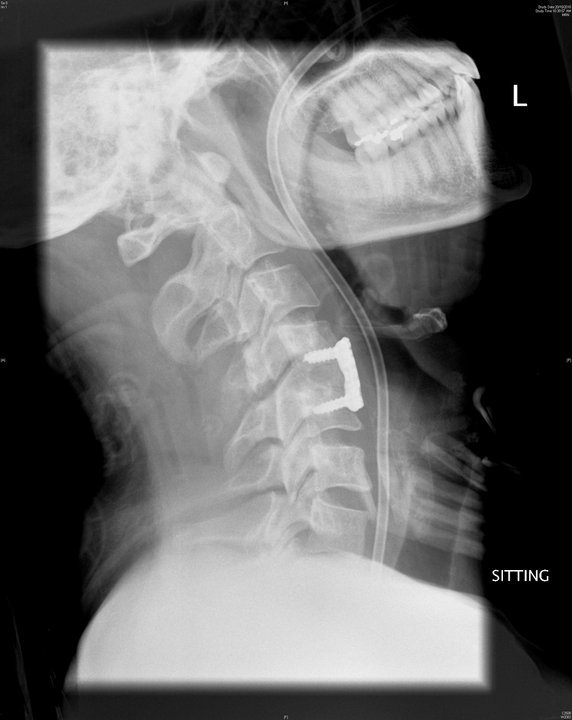
He continued (speeding up again), laying before me the basics of spinal cord injury. The spinal cord is approximately the diameter of a finger, consisting of millions of nerve fibres that transmit information from the brain down to every part of the body (instructing the muscles of the body to move), and in the reverse direction, providing feedback (sensation, both pleasant and painful). In their traverse to and from the brain, the nerves of the spinal cord are protected by the vertebrae that make up the spine. Nerves that exit the cervical vertebrae (C1 to C8 – the upper section of the spine) control breathing and supply movement and sensation to the neck, upper trunk arms and hands; those that exit the thoracic vertebrae (T1 to T12) supply movement and sensation to the trunk and abdomen; those that exit of the lumbar and sacral vertebrae supply movement and sensation the legs, bowel, bladder and sex organs.

(He gave a thoroughgoing description, which I have paraphrased. He was treating me as an intelligent adult, and I really appreciated it)

“Your break,” he went on to say, “is the fourth and fifth vertebrae but you seem to have most of your C5 function; shoulders and bicep. What is impacted is everything below C5 level; wrist (C6), triceps (C7), fingers (C8). Obviously, everything else below the trunk is damaged.”

I have asked other doctors the same question but I asked again. “Is it a good sign that I have some feeling below the level of my injury, however muddy” (I can sense touch but not hot or cold. I cannot feel needles, which is some compensation).

Bonnie’s response confirms what I have already been told. “Motor neurons and sensor neurons traverse distinct parts of the spinal-cord. It is possible for a person to have feeling and no movement and, conversely, to be able to move without feeling”; he went on to describe the surprising difficulty of walking without sensation in your feet and legs.

In terms of prognosis (and again I paraphrase), the problem is that science has not yet reached the point that it can scan to the level of the neuron (which is more than 1000 times thinner than a human hair), so we have no way to determine the extent of the damage in the case of an incomplete injury. At the time of an accident the area of injury swells and goes into shock – a little like a swollen ankle. Over time, the swelling subsides and undamaged neurons are able to resume their function. Most recovery is had in the first few months – and there is something of the J curve effect thereafter. By six months to a year the injury has largely stabilised, but recovery may continue through the following year, sometimes later. There is simply no way of knowing, and so no real way of planning for the future.

His conclusion is worth quoting in full (I can pretty much remember it verbatim). “An incomplete injury is a blessing; it means that recovery is possible, we just don’t know how much or how little, or how long it might take. It can also bring challenges; it not only makes it difficult to make plans, but it can give rise to additional hardships – not least of which can be pain below the level of injury. Increased sensation is not always positive, but is better than having no feeling at all.”

This was a lot to take in, but Bonnie’s thorough and brutally honest explanation was precisely what I needed. He finished with a challenge:

“Whatever your neurons do and don’t do is largely out of your control. But if you work hard, if you use the muscles you have and exercise those areas that are experiencing improvement, you can make the most of whatever level of return you get. Even if that return is minimal, you can learn to function and flourish, with wheelchairs and mechanical aids and computers. You still have some say in the shape of your future.”

I like that. It is incentive enough, at least, to help me cope with what is coming next.

So, now I am about 2 ½ years down the track from the accident, I am at the point where my injury seems to have stabilised. So where do I stand (don’t you love the English language)? Well, in a word “imbalanced.” Obviously I have the function typically available to those with a C5 injury (biceps, shoulders, partial chest and above). Because I am an incomplete quad, I have had further recovery. Below the chest there is not much in the way of functional movement – a few odd muscle tweaks here and there; party tricks I call them. In terms of my arms, while my left side has changed little, my right side has regained some useful (although weak and awkward) movement in my triceps, wrist, and fingers, which have provided me with the ability to eat and drink (I still need help cutting things up), use a computer mouse (an extra large trackball), pick up and replace objects, throw food at my children (inaccurately and only at close range) and the like.

I still need carers for all sorts of tasks (mornings and evenings obviously, as well as for various functions through the day), but probably my biggest disappointment is that I have not had the recovery needed to enable me to independently transfer. Of all the potential capacities, the most important for a quadriplegic looking to increase independence is the ability to transfer – to move oneself from bed to a wheelchair and from there to any number of places; a car, so as to avoid the limitations of having to drive a powered chair onto the back of a modified bus/van; a lounge, to be able to sit next to your wife, cuddling her as you watch TV; a bed, so that you can choose for yourself when to go to sleep.  I spent a year trying to pick up this skill with the awesome physios at Prince of Wales hospital (Fernanda and Keira the legends), but didn’t pull it off. With help, I can move from bed to a chair if there is no slope (unrealistic in the real world), but a hoist is the more efficient and safer mechanism. Obviously, it has its limitations.

In terms of feeling, there is not been much change since the early days. I have partial, muddy, feeling below the level of injury. I can generally tell when I’m being touched, but you could stab me and I’d probably not complain too much (as long as you cleaned up the mess). I can’t feel hot and cold. If I pick up a hot cup, my hand responds with an automatic spasm, so I have to be extremely careful with tea and coffee. I get pain in various parts of the body but am able to manage it. I take a few drugs, and the other key is to learn to refocus the mind. The brain turns out to be a pretty powerful pain reliever – at least most of the time. the feeling that I have gives me some advantages, especially since I can often tell if something is going wrong.

All of this is a long winded way of saying, were he still alive, I could beat the man of steel in an arm wrestle.

Image

Not yet a grandfather

Not yet a grandfather

Having spent a week in bed I was up and about yesterday. The world looks better from this angle. At church today I was given this baby to nurse. I was especially pleased that he seemed secure enough in my arms – good news for when I have grandchildren – not too soon I hope.

The joys of bed (seven days in paradise)

I am on my seventh day of bed rest, lying on my side waiting for a pressure mark to disappear. When it first appeared it was only small and I assumed it would heal up after a couple of days. A week later and my carers have only just started to see some improvement; what was a small enough mark on the surface is obviously more substantive underneath. Being in bed is one thing but lying on my side is another. It is not only the niggling painof the body cramping from being oddly positioned, but that it is so hard to do anything lying sideways. Voice recognition software means I can use the computer but reading text on an angle is surprisingly difficult. The brain seems to be trained to track texts left to right but when proceeding bottom to top I keep repeating or skipping lines bottom to top I keep repeating or skipping lines.

As each day goes past, and my dreams of being up and about on the next come to nothing, I am getting increasingly grumpy. When my carers check my bum in the morning and tell me that the mark is still there I am tempted to tell them to @$*& off. In the spirit of the idea that positive talk is transformative, here are some reasons to celebrate being in bed:

  1. … (Very long pause as I wrack my brain) the Cat has 24-hour bed service – see photo
  2. I have the opportunity to sleep whenever I choose
  3. I am allowed to watch the test cricket, Australia vs South Africa (although a five-day test that Australia should have won ending in a draw didn’t help my mood)
  4. I’ve been able to finish my marking and even do some of my own writing
  5. the boys are able to stay away from me to avoid getting jobs (a blessing to us all; they avoid work and I dodge a fight)
  6. I missed travelling home in the rain earlier in the week, and will be able to remain inside when heat-wave temperatures hit us (predictions of 41°)
  7. I get waited upon hand and foot – even more than normal. And Elly insists that this is literal, and that my feet and legs are bloody heavy

I’m feeling better already… But God help the carers if they find the mark still there tomorrow.

Film Review: The Sessions

The Sessions is a magnificent film, although my attempt to describe it to others has met with underwhelming response. My son, Jeremy, went as far as to comment, “where do you find these weird films, dad?”

It tells the true story of Mark O’Brien (John Hawkes), a 39-year-old polio victim who spends most of his life in an iron lung – a machine that looks something like a diving compression chamber, without which he can breathe for only a few hours at a time. Because of the severity of his disability, with its impact upon the function and shape of his body (as he says, “someone who was not an attendant, nurse, or doctor would be horrified at seeing my pale, thin body with its bent spine, bent neck, washboard ribcage, and hipbones protruding like outriggers” – see note 1), Mark has not experienced sexual intimacy. And so he hires a sex surrogate, Cheryl (Helen Hunt), who helps him work through his fear and experience the joys and frustrations of sex.

So, a disabled man has sex. How do you make a quality movie on the basis of such a premise? For a start, you give a naked Helen Hunt plenty of screen time! This 49-year-old star has a beautiful figure – but the film manages to reveal the natural beauty of her body and her character without the sensationalism or gratuity of so much of the Hollywood portrayal of sex. Perhaps this is because her nudity is set alongside that of Mark, although this implies a “beauty and the beast” motif which the film also manages to avoid. In fact, it somehow evinces the beauty and strangeness of all bodies, along with the exquisite joy and disappointments of sex. In doing so, the film explores a vital element of what it is to be human; the challenge of living within the limits of our broken and finite bodies, and the longing for a connection with others that is both psychological and physical.

Elly and I watched The Sessions together. Its themes were probably too close to home, yet in some weird way, I suspect every person will be able to recognise something of their own problems and insecurities in this story – while also being reminded of the blessings and opportunities of their own life.

The Sessions – a triumphant tearjerker, 4.5/5 stars.

PS: the film also explores O’Brien’s Catholic faith, and his friendship with his parish priest. The potency of this relationship perhaps arises from their shared virginity, and also from their honest wrestling with the grace and vicious humour of God in the face of the problem of pain.


Note 1: the film is based on an article written by Mark O’Brien, “On Seeing a Sex Surrogate”, the Sun, May 1990. It is available at the following link, http://longform.org/author/mark-obrien/ – in my view, best read after seeing the film